Thursday, December 29, 2011

High Winds

Today the high winds have taken their toll on some of our Elk fencing that is protecting the greens.  Every day we are checking to make sure the fencing is still up and undamaged by the wind or wildlife.  Most of the time when repairs are needed they are relatively quick and easy to do. 

Generally the area of failure comes from the rope rubbing against steel poles causing the rope to break. We have been installing sleeves made out of old hose to help reduce the friction on the rope in these wear areas.  The fence installation has been an ongoing experiment and we are continuing to find out better ways of securing the fencing material to the post.

Wednesday, December 28, 2011

At First Look

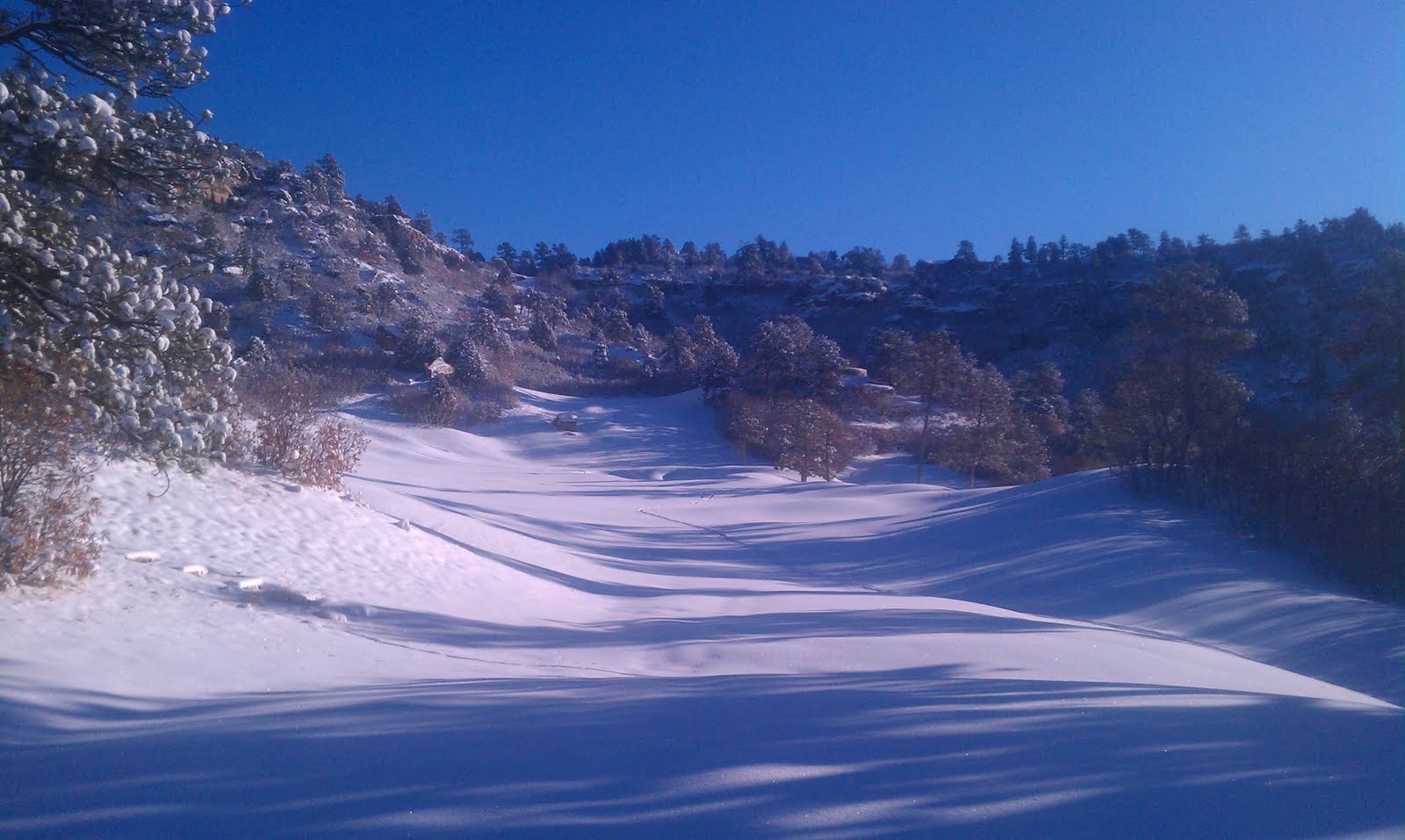
With a little over three weeks of snow cover on the golf course, today I took my first peek under the snow to see how things are doing. The area of greatest concern is always the greens and as of right now they look great. The snow is more than one foot deep and is all still powder which allows for great air and light movement to the turf below.

All turf managers biggest fear is the formation of a lasting ice layer under the snow which will over time suffocate and eventually kill the turf. Poa Annua is the most vulnerable to this problem and fortunately for us our Poa populations are not terribly high. Damage to Poa can occur in as little at 14 days whereas Bentgrass can withstand prolonged cover of more than 30 days with out problem.

The snow is still very light and powdery with a thin crust on top which is actually holding the snow cover in place against the strong winter winds. Another side benefit from using fencing to keep the elk of the greens has been the fact that the snow on the greens has been untouched. All of it remains light and fluff and not packed down by foot traffic which also can lead to ice formation.

The seven day forecast looks to be warm with high winds, so a great potential for significant snow melt exist. We will be closely monitoring the melting and take any necessary actions to protect the greens from ice forming. This could include complete to partial snow removal and making sure no excess water freezes on the greens surface.

There is no off season when it comes to managing turf, the only thing that changes are the situations that create a different set of  problems for turf loss.

Friday, December 23, 2011

Picture Perfect

The timing of our latest snowfall could not have been better for providing us with a white Christmas. I would like to wish everybody happy holidays and a Merry Christmas.

Tuesday, November 15, 2011

Another One Is Done

As the wildlife activity increases another green has been shut down for the season.  The latest green to be closed is #6 which was one of the most heavily damaged ones last year.

The fencing has been put up and but unfortunately some minor damage has already occurred. That being said the entire green was dormant seeded and then covered with a heavy layer of sand to help insulate and protect the green throughout the winter.  The hoof marks appear to have only scraped away the turf leaving the crown of the plants in tact which should allow for a full recovery.  If not new seed is in place to help repair these areas come spring.

Additional greens will be closed as deemed by the wildlife traffic.  Eventually they will all be shut down by the 1st of December.

Close Up of Hoof Damage

Heavy Sand Topdressing

Friday, November 11, 2011

The Replacements Are Here!


We have begun replacing some of our trees that have died in the last several years with new ones that will help re-vegetate these areas.

This fall we are planning on planting 10 new pine trees that will range in height from 16' to 22' tall so that they do not look out of proportion with the surrounding trees.  These trees will be a combination of both Austrian and Ponderosa Pines which will add some genetic variability to the Forrest.

Thursday, November 3, 2011

That's A Wrap

It looks like things on the golf course are coming to a rapid close for the season after the last snowfall of more than 10". Fortunately for us there are only a couple of things remaining on the course that needs to be done before winter sets in for good. Earlier this week we were able to accomplish a few critical tasks that needed to happen before the snow fell. These would be preventive applications for snow mold control on greens and tees, additionally a dormant fertilizer application was made to the fairways.

This fertilizer application will supply the nutrients to the turf immediately and allow the plant to store "food" (carbohydrates) for next spring. An effective late fall fertilization will benefit the turf by producing carbohydrates, encouraging early spring root growth, providing good spring color and improving turf density.

Next week  we are scheduled to blow out the irrigation system and it looks like we will be doing it with snow on the ground.....again.

Friday, October 28, 2011

Mocking Up

Today we began the process of finalizing the Elk fencing installation. As the parts required for the fencing continue to arrive, we finally had the chance to put together a working version of my concept plan.  What you see in the picture above  will become the future of our winter greens protection program.

All things considered the design will stay essentially the same but minor tweaks will be done to ensure the Elk remain on the out side looking in.

Tuesday, October 25, 2011

Back By Popular Demand

Due to the overwhelming positive comments we received this year about our new expanded intermediate rough  cuts, we will be adding a few more.  These new  areas will be found on holes #1,#3,#7,#15 and #18.  All in all these areas will make up about 40,000 sq ft or just under an acre of new intermediate rough.

These extra cuts are targeted in areas where the higher handicap players tend to hit, now these areas will be more player friendly and help with pace of play. 

Friday, October 21, 2011

What Are The Blue Dots?

What are the blue dots around some of the greens are for ? The answer is that we are marking the locations for fence posts that will installed to support material to protect the greens from winter wildlife damage. The post will be spaced every 25 feet to provide enough support for the fencing material. Once we have layed out the initial post configuration we will then locate the underground irrigation system components before any posts are installed. 

You all are aware of the damage that was caused to the greens by the Elk last year and we will be doing all that we can to avoid a repeat of that damage. Currently the greens are scheduled to go on temporaries beginning December 1st as they are every year, at this time the greens will be closed off with fencing for the remainder of the winter season. There is also a chance that some of our more trafficked greens will get fenced off before the December 1st date, the most likely candidates for this would be greens #4,#6 and #10. In one night the damage caused by the Elk can require month’s of recovery time that includes wasted man hours installing thousands of replacement turf plugs to the greens.

These fences will be eight feet tall in order to keep the wildlife from jumping over them. We are still currently engineering the final configurations of the fences, but at this point they will be constructed out of steel fence post and tennis wind screens will serve as the fence boundaries. The reason we are using a fabric as the fencing itself is so that we can still easily access the greens during the winter for maintenance purposes. A more rigid material will become unworkable in the middle of winter when temperatures are routinely in the single digits.

Once again the Board has stepped up and provided the necessary funding for this extremely important project of protecting our greens. In the next several weeks we will begin to install the post for the fences at the greens locations in advance of the ground freezing. These post will be in play, so if your line is effected you will be allowed to take a drop from the obstruction. These post will be an inconvenience for some of our later season play, but I believe the benefits will far outweigh the damage that is caused annually. The wildlife is spectacular to see up close and personal, but it comes with at a price.

Wednesday, October 19, 2011

Turf Slapped

A Golf Course Superintendent could only wish.......

Monday, October 17, 2011

And So It Begins

It is once again that time of year when the wildlife namely the Elk and Deer have a negative effect on the golf course. These animals have been back for a while but until recently their damage was minimal. It seems as if each morning we are finding more and more damage to the turf throughout the golf course.

This year the Board has funded a greens protection program in which protective fencing will be installed at most of the greens that have had historical damage to them. The timing for fencing will be around the 1st of December which is our traditional date for closing the greens and utilizing temporaries throughout the winter months. The timing could change for our more trafficed greens by days or even weeks. We will begin installing the support post in the next several weeks before the ground becomes frozen and we are no longer to get them in the ground. These post will be there long before any of the fencing goes up and will add some additional challenges for the golfers around the greens complexes.

This protection will go a long way in helping to protect our greens from avoidable damage in the winter months. It will be a welcomed change in the spring to not have to spend the first several months repairing the damage to the greens. Thousands of plugs and and countless man hours will be spared and will be more effectively utilized elsewhere. 
Urine Burn


Hoofing It Up

Friday, October 7, 2011

Needle Drop


One would think that a tree classified as being an evergreen would mean that pine
trees keep their needles indefinitely. Pine trees actually only keep an individual needle for
two or three years. After that time period, the tree stops feeding the older needles and the
needles die in the fall, turn yellow or brown, and drop off the tree.

Each spring the pine trees grows new set of needles, while each fall the pine tree sheds its oldest set of needles. Some years a pine tree may shed two sets of old needles, making the fall needle drop even more apparent. This year with the abundant moisture in the we had a great year of needle growth.

This fall there is an incredible amount of needles that are going to fall and fortunately for us us the last several days of high winds have blown the majority down in one shot.  Now the cleanup begins.  

Older Needles Turning Brown

Tuesday, September 27, 2011

It Looks Nice But Don't Touch

Poison Ivy [Toxicodendron radicans]  is found throughout most of the United States and southern Canada. Poison Ivy can grow as a self-supporting woody shrub or as a thin trailing vine running along the ground and even an  aerial-rooted vine growing on shrubs, trees, power poles, and fences. Older (ten years or older) vines can grow to several inches in diameter as high as 30-feet.

Poison Ivy is a perennial plant that is reproduced by seeds and woody rhizomes. Over the years the populations have steadily grown throughout the Village and is now on the verge of becoming a major problem.

As a result of this we have stepped up our efforts to help control this dangerous weed. Currently the Poison Ivy is very easy to spot due to the beautiful fall color that it is currently displaying, Don't be fooled though stay away. We have been using mixtures of broad leaf herbicides to control it with varying degrees of success. The Ivy is very hard to kill due to its waxy leaf surface that makes herbicides unable to be effectively absorbed by the plant. As a result of this several herbicide applications may be necessary to completely control this plant species. 

Friday, September 2, 2011

A Little Help

We are scheduled for our fall aerification October 3rd thru October 5th on all of the play areas. That being said, yesterday we went out and aerified the greens on holes 4 and 10 in efforts to help these two greens which have struggled since they were sodded last year. These two greens have never really rooted properly and I decided it would be in the best interest of the overall greens health to punch these an additional time before October. It will take a couple of days for the excess sand to become less visible as the green grows out through it. This extra aerification will go a long way to help with rooting and a disruption of the sod inter phase layer that has had a negative impact on sod establishment. Couple this with cooler temperatures and additional nutrients applied, the greens will have a fighting chance to become a real green one day.

Wednesday, August 31, 2011

Watch The Video

The wear and tear on the golf course continues to mount as another summer month has come to an end. The Golf Shop has put together a GREAT!!! video that shows the correct way to care for the golf course while your out playing. I would personally like to thank The Director of Golf George Kahrhoff and Assistant Golf Professional Brian Nishi for taking the time to put together this great teaching tool. This goes to show that the Golf Shop and Golf Course Superintendent can work well together.

Tuesday, August 16, 2011

The View From a Intern


For the last fifteen years we have had a highly successful Internship program here at CCCP. Many of them have moved on to become Assistant and Golf Course Superintendent's at other clubs both in and out of the state of Colorado.

Not too long ago one of my Interns from this year  William Sechrist asked me if he could write a blog post for me.  I was thrilled to hear that he wanted to write one and I am happy to say this will be the first non Sean McCue post in this blog. Enjoy the  perspective from a young man working his way up the ranks that has a bright future in the industry.   


Every day at the County Club at Castle Pines begins the same. The convoy of carts from the maintenance shop makes its way up the cliff to the club house. As I drive up the dark cliff I gaze over to see the rising sun hitting the mountains. I have always imagined how awesome it would be to not only wake up to the sunrise, but also the Rocky Mountains, and this summer has been unforgettable.

A good internship is one where you are communicated with and feel involved. It is important to feel that you can give your opinion and that your ideas, good or bad will be considered. The Country Club at Castle Pines has two interns and the one-on-one time with Sean and his two Assistants has been very valuable.  Other high profile Country Clubs commonly have four or more summer interns and may look good on a resume, but the experience that is gained is far less than it should be.   What has made my internship at CCCP so enjoyable is the variety, each day brings new challenges in which I can learn and grow from. However big or small the golf course is, the work is going to be hard and you have to give your all each and every day. You must expect to work long days with very little time off, but the hard work pays off in the end with the experience gained which will solidify my future in the industry.  

There are two summer interns this year. I am currently enrolled in the Turf Management program at Rutgers University in New Jersey. It is a great program with a lot of intelligent experienced professors whom are all connected to the golf course industry. I am enjoying bringing what I’ve learned in the classroom out to the golf course and applying into real world situations. 

Students come from all over the country to attend Rutgers University and the majority of the internships that are taken remain back east. I came to Colorado looking to experience how differently golf courses are maintained out west in an arid climate.  Combining this with my previous work experience in Kentucky, Ohio and Georgia will help to solidify my agronomic foundation. Believe me when I say there is a BIG difference and there is plenty to learn out here! My experience at CCCP this summer has been everything I hoped it would be and more. I will miss it when I leave in October and if lucky, I’ll be back some day!

Friday, August 12, 2011

Whats In My Cart

Earlier in the year Epic Creative came out to shoot pictures and video on the golf course as a follow up to see how the Bentgrass fairway conversion is doing.  Epic originally came out in 2007 to first document the success we were having with our Bentgrass fairway conversion.

What started out as a photo shoot and interview went horribly wrong when they asked me to show them whats in my cart. As you can see it has a lot of things that are needed on a moments notice on the golf course.  My cart is kind of a mobile office, tool box and trash can all rolled into one.

The video can be found Here enjoy.

Monday, August 8, 2011

The Birth Of A Green

In an earlier post I mentioned a grow in taking place on our North Chipping Green, well the grow in is complete in just 42 days!  We have shifted the maintenance of this green from a grow in to being included in the normal daily maintenance of the other established greens on the golf course. This includes daily mowing, grooming, fertility, irrigation and topdressing. 

You all have heard the old saying it's like watching paint dry or grass grow.  Well now you can actually watch this take place. I documented the grow in process by taking a daily picture of the green to show how things change from day to day.

Enjoy the video.

Thursday, August 4, 2011

Does Anybody Care?

Everybody is quick to point out the flaws in the maintenance of the golf course, but it seems as if rules and etiquette don't apply to anyone. With more than 5200 rounds in the month of July, the golf course is getting worn out. You need to do your part while playing to help maintain your golf course and help with the overall member experience

Do your part, fix your ballmarks, replace your divots, rake bunkers and follow all  cart signage and traffic ropes. These seem like things that should go with out saying, but that is not always the case.

I have a staff of hard working men and women that give their all each and every day to make CCCP a better place and it becomes frustrating to them when people seem to take for granted the effort that is put in every day.

Here is what my staff gets to see most mornings on the golf course at first light.  There is a lot of activity taking place on the course after hours of which is not helping anyone out. Practicing on the golf course is prohibited! If you see someone out practicing on the course at night tell them to stop, or if you are not comfortable doing that call the golf shop or even Emergency Services and let them handle it. These people who are out routinely practicing at night are ruining your golf course.

Do your part, it is your golf course after all.

Practicing on the course at night.


Lack Of Respect


Divots taken off greens


Playing catch with dogs on the fairways


Carts

Taking sharp turns
 Running over traffic stakes


Thursday, July 14, 2011

Growing In

The re-grassing of the North Chipping Green is coming along nicely.  It has been three weeks to the day since the initial seeding and it almost looks like a green again.

The north chipping green was stripped of sod earlier in the year to use for repairs made to the other greens on the course after some winter damage occurred. We were forced to use the chipping green as a nursery because our old nursery green was abandoned due to a previous construction project.  Later this summer we will be reestablishing a new nursery green so that we will have grass available in the future.

The north chipping green was seeded with two improved Bentgrass varieties, The green was split in half as a side by side test of the two different varieties. One side of the green was seeded with A-4 and the other T-1. These grasses will be evaluated for future overseeding into the existing greens based on the their performance on the chipping green.  Initially the T-1 is out establishing the A-4, but time will be the true determining factor as to which grass performs best under our difficult growing conditions.

Germination 6 Days From Initial Seeding


T-1 21 Days After Initial Seeding
A-4 21 Days After Initial Seeding