Thursday, December 29, 2011
High Winds
Generally the area of failure comes from the rope rubbing against steel poles causing the rope to break. We have been installing sleeves made out of old hose to help reduce the friction on the rope in these wear areas. The fence installation has been an ongoing experiment and we are continuing to find out better ways of securing the fencing material to the post.
Posted by Unknown at 3:03 PM 0 comments
Labels: Elk, Greens, High Winds, Wildlife Management
Tuesday, November 15, 2011
Another One Is Done
As the wildlife activity increases another green has been shut down for the season. The latest green to be closed is #6 which was one of the most heavily damaged ones last year.
The fencing has been put up and but unfortunately some minor damage has already occurred. That being said the entire green was dormant seeded and then covered with a heavy layer of sand to help insulate and protect the green throughout the winter. The hoof marks appear to have only scraped away the turf leaving the crown of the plants in tact which should allow for a full recovery. If not new seed is in place to help repair these areas come spring.
Additional greens will be closed as deemed by the wildlife traffic. Eventually they will all be shut down by the 1st of December.
Close Up of Hoof Damage
Posted by Unknown at 3:51 PM 3 comments
Labels: Elk, Fencing, Sand Topdressing, Wildlife Management
Friday, October 28, 2011
Mocking Up
All things considered the design will stay essentially the same but minor tweaks will be done to ensure the Elk remain on the out side looking in.
Posted by Unknown at 1:19 PM 0 comments
Labels: Elk, Fencing, Wildlife Management
Friday, October 21, 2011
What Are The Blue Dots?
What are the blue dots around some of the greens are for ? The answer is that we are marking the locations for fence posts that will installed to support material to protect the greens from winter wildlife damage. The post will be spaced every 25 feet to provide enough support for the fencing material. Once we have layed out the initial post configuration we will then locate the underground irrigation system components before any posts are installed.
You all are aware of the damage that was caused to the greens by the Elk last year and we will be doing all that we can to avoid a repeat of that damage. Currently the greens are scheduled to go on temporaries beginning December 1st as they are every year, at this time the greens will be closed off with fencing for the remainder of the winter season. There is also a chance that some of our more trafficked greens will get fenced off before the December 1st date, the most likely candidates for this would be greens #4,#6 and #10. In one night the damage caused by the Elk can require month’s of recovery time that includes wasted man hours installing thousands of replacement turf plugs to the greens.
These fences will be eight feet tall in order to keep the wildlife from jumping over them. We are still currently engineering the final configurations of the fences, but at this point they will be constructed out of steel fence post and tennis wind screens will serve as the fence boundaries. The reason we are using a fabric as the fencing itself is so that we can still easily access the greens during the winter for maintenance purposes. A more rigid material will become unworkable in the middle of winter when temperatures are routinely in the single digits.
Once again the Board has stepped up and provided the necessary funding for this extremely important project of protecting our greens.
In the next several weeks we will begin to install the post for the fences at the greens locations in advance of the ground freezing. These post will be in play, so if your line is effected you will be allowed to take a drop from the obstruction. These post will be an inconvenience for some of our later season play, but I believe the benefits will far outweigh the damage that is caused annually. The wildlife is spectacular to see up close and personal, but it comes with at a price.
Posted by Unknown at 4:12 PM 0 comments
Labels: Fencing, Golf Course Damage, Wildlife Management
Wednesday, October 19, 2011
Turf Slapped
A Golf Course Superintendent could only wish.......
Posted by Unknown at 11:22 AM 1 comments
Labels: Course Care and Etiquette, Videos, Wildlife Management
Friday, April 8, 2011
Polka Dots
I am not sure which is more difficult, the winter weather or the wildlife damage to the course each year. It seems as if every year we cannot escape winter without some sort of damage. This year with the winter weather being more mild than usual the course is beginning to come out of dormancy in good condition. The exception being the areas that were damaged by the Elk and Deer.
With a lack of snow cover for most of the winter the turf was exposed to the resident wildlife and they had a ball out on the course. Our biggest issues out on the course are the numerous areas of urine burn from the Deer and Elk. The areas in the fairways have already been seeded with Bentgrass and the areas on greens will have to be plugged out. The plugging on greens will not take place until after aerification due to the fact that the repaired areas might pull up from being aerified. This process will take several days to complete and then a couple of weeks for the repaired areas to blend in on the greens.
The hoove marks on the greens appear worse than they are, the damage that was caused is on the surface above the crown of the plant. The plant will regenerate new tissue and repair itself from this damage as soon as active turf growth begins to take place. During aerification additional seed will be applied to these areas to help with recovery.
Urine Burn on #10 Fairway
Urine Burn and Hoove marks on #7 Green
Posted by Unknown at 2:49 PM 0 comments
Labels: Bentgrass Fairways, Wildlife Management
Tuesday, October 26, 2010
Stampede
The Elk and Deer have been at it again. With the recent rains we have finally received, the golf course has been a little on the soft side which is not a good combination for the heavy footed animals.
Damage To #7 Green
Damage To #7 Fairway
Over the last week in particular the damage has been getting worse, so we have started putting out lights on the more trafficked greens in hope of keeping the Elk off. These light help, but ultimately the Elk and Deer will end up going wherever they want especially when they are on a full run.
Blinking Light In Action
With the cooler weather setting in the ground will begin to freeze which will be our best defense against the damage we are currently dealing with. After each damaging occurrence we will fix each area as best we can and hope that we can ride out the storm of damage.
Posted by Unknown at 8:48 AM 1 comments
Labels: Elk, Wildlife Management
Wednesday, January 7, 2009
Snow Management
One of the biggest challenges we deal with in the winter is managing the snowfall received. I am not referring to snow removal from the paring lots at the clubhouse, but rather management of snow on the vital play areas on the golf course.
We routinely remove snow from our four most shaded greens after each snow event. This is done to help prevent any ice build up from occurring due to the freezing and thawing that takes place where extended snow cover occurs. The timing of the removal revolves around predicted forecast, so that we are not clearing greens prior to the onset of extremely low temperatures. When cold weather is predicted we will leave the snow on the green to insulate it until the extreme temperatures pass and then remove the snow from the greens. This is a cycle that takes place throughout the entire winter. Due to the constant snow removal we have to add supplemental moisture to these greens in the form of hand watering. It is not uncommon to see the greens being watered when the surrounding areas are still deep in snow cover.
A Cleared Green
Wildlife also has an effect on snow found on the golf course. With herds of both Elk and Deer roaming the property they cause a distinct set of issues. The constant foot traffic causes compaction of the snow, which can lead to the formation of ice below potentially causing a smothering from extended ice cover. Additionally one of the other unique problems that occur comes from where the animals bed down. Their body heat melts the snow leaving large areas of exposed turf. It seems like the animals target our most problematic areas on the course, which forces us to either hand water or physically add snow back to these areas.
Snow Melt From Animals Bedding Down
Posted by Unknown at 8:29 AM 0 comments
Labels: Wildlife Management, Winter Agronomy
Friday, August 8, 2008
They’re Back
Hoof Prints and Droppings Across a Green
The deer have been around most of the summer and other than eating flowers and the occasional hoof prints they really do not do much damage. The elk on the other hand cause significant damage with their droppings, urine burn and major hoof marks. It is a little unusual for the elk to be around this early in the season, but the extreme weather patterns we are experiencing must influencing their patterns as well.
Posted by Unknown at 5:15 AM 0 comments
Labels: Wildlife Management
Thursday, April 24, 2008
Party In The Pines
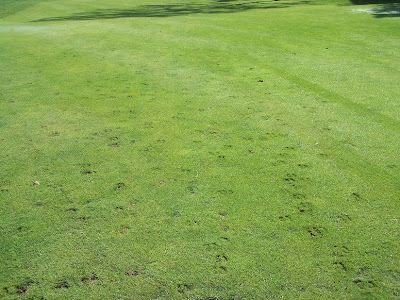
As if things aren’t difficult enough maintaining the golf course with heavy member play, try factoring in unwanted Elk damage. Last night the Elk were very active on the course leaving their trail of destruction over four different holes. We were very fortunate that the herd did not cause more damage than they did. The two greens they traveled over (#7) received only minor damage and most of the repairs were made using a ballmark repair tool. The hoof marks were lifted and pulled back together as if were a ball mark, this damage will grow out in several days.
Hoof Marks Going Across The Green
The damage to the fairways was also minor with no additional work needed to repair the hoof marks that were created. The next time the fairways are mowed the rollers that are on the cutting units will smooth out any of the disturbed areas.
Hoof Marks In The Fairway
The most damage to the course was caused in the waste bunker on #6. All that is required to address this problem is to run the mechanical bunker rake through it and all of the prints and ruts will be smoothed over.
Posted by Unknown at 12:35 PM 0 comments
Labels: Wildlife Management
Sunday, April 6, 2008
Pesticide Usage
The Facts About Golf Course Pesticides
Golf Courses are:
• Community green spaces that provide recreational opportunities and also offer and enhance wildlife habitats.
• "Air conditioners" that produce vast amounts of oxygen while cleansing the air of pollution and cooling the atmosphere.
• Water treatment systems: Healthy turfgrass is an excellent filter that traps and holds pollutants in place; courses actually serve as catch basins for residential and industrial runoff; many courses are effective disposal sites for effluent wastewater.
• Among the best ways to reclaim and restore environmentally damaged sites, such as landfills.
• Businesses that contribute substantially to communities through employment, taxes, property value improvement and enormous charitable support.
Scientific Data:
• Independent university research supports the fact that well-managed golf courses do not pose significant risks to environmental quality, wildlife or human health.
• The modern pesticides and fertilizers used to maintain healthy golf course turf have been thoroughly tested and are considered safe when used according to label directions.
• A pesticide product today has typically undergone more than 120 studies at a cost of $50 million before it is registered by the Environmental Protection Agency.
Today's Golf Course Superintendents are educated professionals who care about environmental quality.
• Most of today's superintendents have college degrees and substantial continuing education.
• Superintendents are the nation's leading practitioners of integrated pest management, a philosophy that reduces the potential environmental risks of pesticide usage.
• Virtually all golf courses employ at least one state licensed pesticide applicator who is trained in environmentally sound pesticide use.
Are golfers at risk?
• No. There is no scientific evidence that golfers face any chronic health risks from the pesticides used to maintain courses.
• Once a liquid pesticide product is applied and the turf is dry or the product has been watered in, there is very little chance of exposure to golfers or others who enter the area.
• Golfers with possible chemical allergies are always encouraged to contact superintendents to find out what products might be in use.
________________________________________
Posted by Unknown at 11:35 AM 0 comments
Labels: Agronomic Techniques, Environmental Benefits, Fertility, Pesticides, Tree Management, Wildlife Management
Wednesday, March 19, 2008
Vole Damage

The longevity of a vole changes slightly from species to species but on the whole voles are one of the shortest lived of mammals. Voles seldom live beyond a year and most do not survive more than two months. To counter their short life span voles have a condensed life cycle and individuals are sexually mature just a month after they are born. Breeding takes place all year round and females will usually mate immediately after giving birth.
Voles can eat their weight daily, and do not hibernate, though they sometimes store food such as seeds and other plant matter in underground chambers, they eat constantly. Voles concentrate on green vegetation in the summer, and switch to mostly grains and seeds in fall. They also eat bark and roots of trees, usually in fall or winter and this damage of trees categorizes them as a pest.
The majority of voles live in grassy areas but they can be found in a variety of environments such as rocky mountainsides, marshes, tundra and even trees. Like many other rodents voles are great burrowers, they live in networks of above-ground "runways" in grassy areas, as well as underground burrows. During the winter these "runways" are constructed through the snow that covers the ground.
Most damage occurs in the winter when voles move through their grass runways under the protection of snow. The reason this generally occurs is that the voles are able to stay hidden undercover from their predators. The animals that generally feed on voles are, Foxes, Coyotes and birds of prey.
Posted by Unknown at 2:20 PM 0 comments
Labels: Voles, Wildlife Management
Friday, February 29, 2008
Elk And The Golf Course Not Necessarily a Good Mix.
Wildlife on the golf course is beautiful to look at, but it does have drawbacks from a maintenance point of view. The annual damage that is caused to the course is not only expensive to repair, but highly disruptive towards providing high quality daily conditions. Most of the problems we are dealing with occur from the Deer and Elk and it’s in the form of urine burn, droppings and hoof prints. Great care has been taken to protect areas on the course that damage commonly occurs by installing protective fencing and flashing lights. Even with some of the protective measures some damage still occurs and requires repairs that range from topdressing and rolling to reseeding or soding of areas.
Elk Droppings
Hoof Damage
Urine Burn
Posted by Unknown at 11:43 AM 0 comments
Labels: Wildlife Management


